
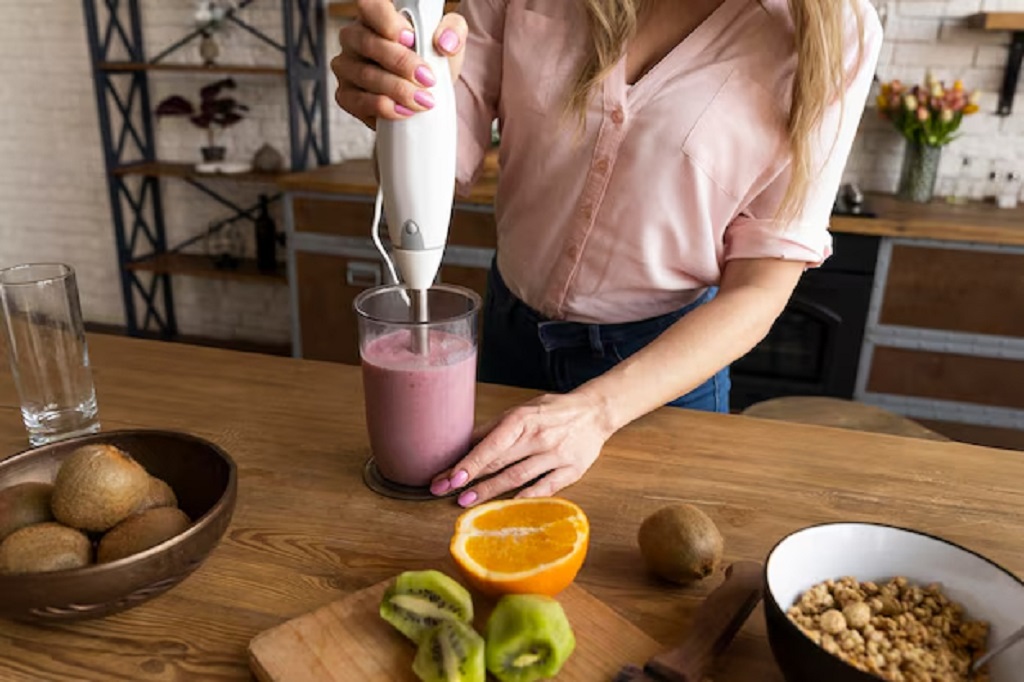
Okay, let’s be real. You’ve probably stood in a kitchen aisle – or more likely on Amazon at midnight – staring at both options and thinking : what’s actually the difference, and which one won’t end up gathering dust at the back of the cupboard ? Fair question. And honestly, the answer depends entirely on how you cook.
Both tools blend things. That’s where the similarity ends. If you want to go deeper on kitchen equipment comparisons before making a decision, a site like https://www.la-cuisine-facile.fr covers a lot of useful ground on the subject.
What’s a stick blender actually good for ?
The immersion blender – also called a hand blender or stick blender – is that long, handheld device you plunge directly into a pot, a jug, or a bowl. No transferring, no mess, no second washing up session.
Where it genuinely shines :
– Soups. You make your soup in the pot, you blend it in the pot. That’s it. If you make soup once a week, this thing pays for itself in saved time alone.
– Sauces, purées, baby food, whipped cream with the whisk attachment.
– Quick smoothies for one person (though it’s not the fastest option for that).
The stick blender is compact – most models are under 35cm long – easy to store in a drawer, and takes about 20 seconds to rinse clean. Perso, I find it way less intimidating than dragging out a full blender just to blend a butternut squash soup.
The downside ? It struggles with hard ingredients. Ice, frozen fruit, nuts – forget it on a basic model. And if you’re blending a large batch of something very thick, your arm will know about it.
What a blender does better
A standing blender – the kind with a jar that sits on a motorised base – is in another league when it comes to power and capacity.
Where it wins hands down :
– Smoothies, especially with frozen fruit or ice. A decent blender like a Nutribullet Pro or a Vitamix will pulverise frozen mango in under 30 seconds.
– Nut butters, hummus, thick dips. The blending jar creates a vortex that a stick blender simply can’t replicate.
– Larger quantities. If you’re batch cooking or feeding a family, a 1.5 or 2-litre jar is a game changer.
The catch is obvious : it takes up counter space. Or cupboard space, which in most British kitchens is… limited. And then there’s the washing up – that jar, the lid, the gasket. Not exactly a joy.
The price difference – does it matter ?
Entry-level stick blenders start around £25-£30 (think Braun or Russell Hobbs). Mid-range, with more power and extra attachments, sits at £50-£80. You can get a solid, reliable immersion blender without spending a fortune.
Blenders are more variable. You’ve got cheap £30 models that’ll burn out in three months, and then high-end options like the Vitamix A2500 at £500+. For everyday use – smoothies, soups, sauces – something in the £60-£120 bracket (Ninja, NutriBullet, KitchenAid) tends to hit the sweet spot.
One thing worth noting : a blender does more per use, but only if you actually use it. A £100 blender that stays in the cupboard beats nothing, but it definitely doesn’t beat a £40 stick blender you reach for every other day.
Which type of cook are you ?
This is honestly the right question to ask before you buy anything.
You probably want a stick blender if :
– You make soups or sauces regularly
– You live alone or cook for two
– Storage space is tight
– You want something quick and low-faff
You probably want a blender if :
– You do smoothies daily, especially with frozen ingredients
– You make hummus, nut butters, or thick dips
– You cook for a family or in larger quantities
– You’re into meal prep
And look – it’s not always an either/or decision. Plenty of home cooks own both. The immersion blender for soups and quick jobs, the blender for morning smoothies. They serve different enough purposes that having both makes sense if you cook a lot.
Can you replace one with the other ?
Partly. A powerful stick blender with a tall blending cup can handle a lot of what a mid-range blender does. Some models come with blending cups specifically designed to work like a personal blender – the Bamix and the higher-end Braun models do this well.
But if you want to blend a full litre of frozen smoothie or make almond butter from scratch ? A stick blender won’t cut it. It’s not about brand or price – it’s physics. The motor and blade design just work differently.
On the flip side, you could technically blend soup in a standing blender – but you’d be pouring hot liquid into a jar, blending in batches, and risking a steam explosion if you overfill it. Not fun. Not safe. Don’t.
So, what’s the verdict ?
If you could only buy one : for most everyday home cooks, a good immersion blender is the more practical starting point. It’s cheaper, more versatile for hot cooking, and you’ll actually use it.
If you’re a smoothie person – and I mean genuinely, every morning, frozen fruit, the whole thing – then a decent standing blender is worth the investment and the counter space.
Can’t decide ? Maybe that’s your answer. Start with the stick blender. If you find yourself wishing you could blend more, faster, with more power – then add the blender later. You won’t regret having both.